
What I learned about auditions and casting behind the scenes
“Here they are, coming with their yellow sheets,” that’s what journalists and editors at the Croatian Radiotelevision would say when they saw phoneticians going to an audition. Those yellow sheets contain the criteria that phoneticians pay attention to: voice, pronunciation of vowels and sounds, diction, prosody, fluency, nonverbal cues. I attended two large journalistic auditions, and of the smaller ones, I followed the one for Lotto Girl, during the coronavirus pandemic. That’s when I virtually noticed Monica, who had a pleasant voice, natural speaking skills, and a warmth that was transmitted to the viewer.
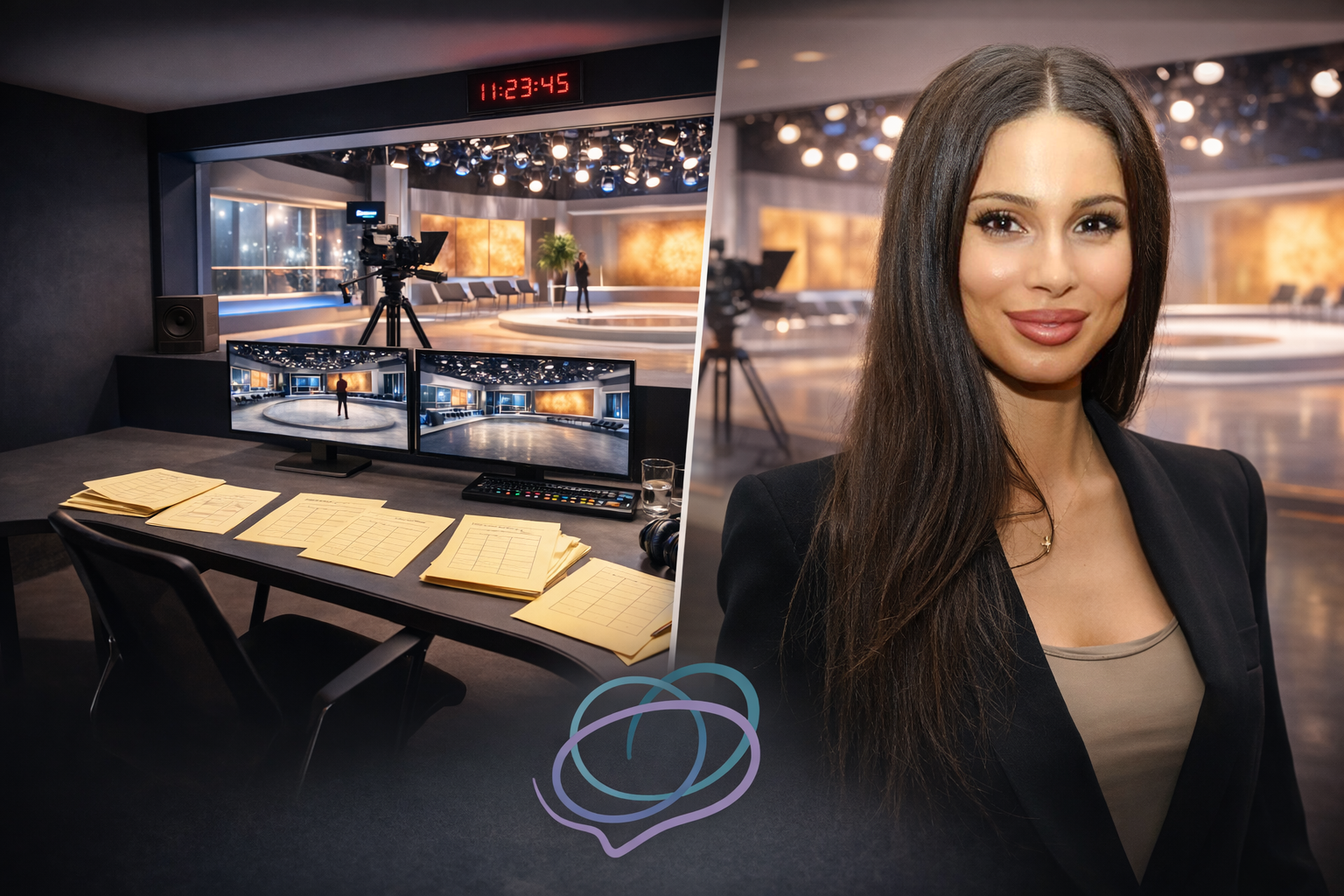
Foto: ChatGPT prema predlošku iz privatne arhive / Monica (privatna arhiva)
Audition vs. casting
When I later started working with commercial television, something confused me. The process of selecting a new host was not called an audition, but rather casting .
What is the difference between an audition and casting, apart from the name? An audition usually tests the candidate's skills, while casting is about whether the person fits the role envisioned. Both have their advantages and disadvantages, if you look at it from the candidate's perspective. The advantage of an audition is that your speaking and public speaking skills are under scrutiny, which is good if you're well-trained, but bad if you're planning to rely solely on charm. I've also met candidates who were not fully aware of their speech impediments (or hoarse voices), and they couldn't understand why they were being passed over at auditions when they had the necessary skills and looked good on screen.
At casting, honed skills are expected (e.g., college actors have stage speech), so they look to see if other nonverbal cues match what (e.g.) the director or editor would want. Recently, a documentary series about America's Next Top Model was released on Netflix, in which Tyra Banks, the model who created the show in America (let me remind you that in Croatia we had our own version with Tatjana Jurić and Vanja Rupena), explains that the production criteria included diversity on screen. When they were looking for a certain profile, candidates outside that profile were simply not considered. Sometimes, the problem with casting is precisely that candidates cannot "rely" on measurable skills, and the decision depends on the vision and impression of the team.
Monica speaks*
Monica, who applied to audition for Lotto Girl at her mother's suggestion, as a French and Italian teacher, could have assumed that voice, speech, and pronunciation would be taken into account.
“ Since I studied foreign languages, I try to cherish my mother tongue and have deep respect for it. I am in love with language in its entirety – semantics, phonetics, and morphosyntax.
Speech is a reflection of who we are: our vocabulary, interests, the books we've read, the people we've met, the places we've been, the knowledge we've acquired... I believe that the way we speak represents us better than our appearance or symbols. It's the impression that lasts. Most viewers first notice how someone speaks.
I am grateful for the opportunity to work with proofreaders and phoneticians, and it is a long, dedicated process. I try to work on my voice and diction, and often people say to me, 'I don't know who you are, but you speak beautifully.' "
So, how can you best prepare for an audition or casting? Like training for a marathon, preparation starts much earlier than race day.
Preparation tips
First, it would be a good idea to set aside some time to work on yourself. If you want to do public work, investing in your voice, pronunciation, rhetoric, and style is never in vain.
If you are preparing for an audition, it is always best to start with breathing and finding a comfortable tone of voice. It is also important to work on the mobility of the muscles that participate in speech production (tongue, lips, cheeks, etc.). For quick results, I created voicelifting , focused on the voice, because the voice carries the largest percentage of the overall impression. Working on speech is not the same as “reading out loud beautifully", so cooperation with a speech coach – a phonetician – will be crucial. *The note that “Monica speaks” is something that my colleagues and I actually wrote down, because at that audition, Monica spoke even though she was reading.
If you are preparing for casting and you have the skills – self-reflection and agreeing with yourself about your boundaries are important. Similar to a job interview, you may be a great candidate, but not for that position. It is good to realize: “If they don’t choose me, I wasn’t the right fit for them,” instead of “something is wrong with me.” If, during the process, you realize you can improve your skills, as in an audition, seek out a coach. Ultimately, auditions and casting are an opportunity to hear how others see you at a certain moment. Those who are at peace with who is looking at them and why are at peace with the result.